0%

Sourcing Vitreous China Tableware wholesale requires more than comparing prices on supplier websites. The right decision combines material knowledge, factory verification, quality control, and realistic shipping plans. Vitreous china is valued for its smooth surface, practical strength, and clean, restaurant-ready appearance. Yet quality can vary between manufacturers.

An experienced buyer should request product specifications before discussing large orders. Check clay composition, firing temperature, glaze consistency, dimensions, weight, and expected chipping resistance. A sample should be inspected under strong light. Look for pinholes, uneven rims, glaze bubbles, color differences, and unstable bases. Small details matter. A cup that rocks on a table can create daily frustration for a busy café.

Supplier research needs evidence, not attractive photographs. Ask for factory addresses, production capacity, quality-control procedures, export experience, and recent food-contact documentation. Independent inspection can verify quantity, packaging, dimensions, and visible defects before shipment. Confirm carton strength as well. A beautifully made bowl is still a poor purchase if twenty pieces arrive cracked.

Cost calculations should include molds, samples, decoration, packaging, freight, duties, and possible replacement rates. Low prices often deserve closer questions. Reliable suppliers explain tolerances and communicate delays early. However, no factory is perfect, and a polished catalog cannot prove consistent production. Trial orders reveal more than promises. Keep written specifications, approved samples, and inspection records for future batches. This practical approach helps restaurants, hotels, caterers, and distributors source durable tableware with fewer surprises.
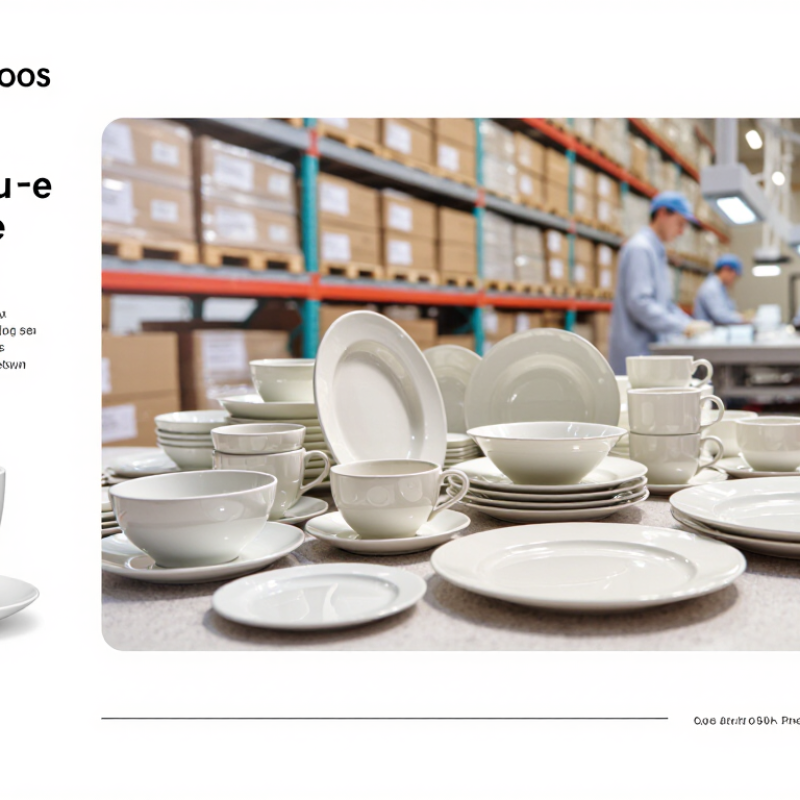
How to Source Vitreous China Tableware Wholesale

Define Vitreous China and Identify Its Wholesale Applications

How to Source Vitreous China Tableware Wholesale

Vitreous china is a refined ceramic made from clay, minerals, and other natural materials. It is fired at high temperatures, creating a dense, glass-like body. This process improves strength, stain resistance, and water absorption control. The surface usually feels smooth and looks bright under dining-room lighting. However, suppliers do not always use this term consistently, so buyers should verify technical details.

Wholesale vitreous china suits hotels, restaurants, catering companies, schools, and healthcare dining services. Common items include dinner plates, bowls, cups, saucers, and serving platters. These products need practical shapes, steady stacking, and reliable replacement availability. Ask for product dimensions, weight, firing temperature, absorption data, and test samples. A sample can reveal uneven glazing, sharp edges, or unstable stacking. I have found that attractive photos often hide small production differences. That deserves attention.

Tips: Compare samples from several factories. Check carton strength and packing methods. Request a written quality standard before ordering. Confirm whether decoration affects durability or commercial washing performance. Do not assume every white ceramic item is vitreous china. Some specifications may remain unclear, and that is a reason to ask better questions, not rush the purchase.

Set Product Specifications, Quality Standards, and Order Requirements

How to Source Vitreous China Tableware Wholesale

Set written specifications before contacting suppliers. Grand View Research estimates the ceramic tableware market could grow at about 6% annually through 2030. That growth increases choice, but also creates inconsistent quotes. Define plate diameters, bowl capacity, rim shape, foot-ring size, unit weight, glaze color, and carton quantity. State tolerances clearly, such as ±2 millimeters for diameter. Small differences become obvious on a stacked dining table.

Quality standards must be measurable. Request test results for water absorption, thermal shock, glaze durability, and lead or cadmium migration. ISO 6486 provides recognized methods for testing ceramic food-contact articles. Confirm dishwasher and microwave suitability in writing. Ask for a production sample, not only a showroom sample. A perfect sample can mislead. I have seen glaze pinholes appear after firing changes. Include acceptable limits for pinholes, warping, crazing, color variation, and foot-ring roughness.

Order requirements should protect both sides. Specify the approved sample code, inspection stage, packaging photos, carton drop-test evidence, and replacement terms. Require pre-shipment inspection before final payment. Record carton dimensions, gross weight, pallet layout, and labeling details. The 2024 Global Packaging Trends report from Smithers highlights continued pressure for stronger packaging and material efficiency. Do not rely on “standard quality.” Define the standard. Yet, one weakness remains: laboratory results cannot predict every handling problem. Trial a small shipment before committing to a full container.

Research and Compare Qualified Vitreous China Tableware Suppliers

How to Source Vitreous China Tableware Wholesale

Researching qualified vitreous china tableware suppliers requires more than comparing catalog prices. Fortune Business Insights reported that the global ceramic tableware market reached approximately US$10 billion in 2023. Hospitality demand remains a major growth driver. This makes supplier reliability increasingly important.

Request physical samples before discussing large orders. Check glaze uniformity, rim smoothness, weight balance, and stacking stability. A restaurant plate should feel solid, not excessively heavy. Ask for firing temperatures, water absorption results, and food-contact safety documentation.

Suppliers with ISO 9001 systems may offer clearer production controls, but certification alone proves little. Review the certificate scope and expiry date.

Also compare defect allowances, packaging strength, replacement policies, and shipment records. A low unit price can become expensive after breakage.

Tips:

Build a comparison sheet with at least three suppliers. Record sample results, minimum order quantities, lead times, testing documents, and payment terms. Ask for a small pilot order. It reveals packing weaknesses and color variation better than promises. The 2024 McKinsey Global Supply Chain report highlights the value of resilient, multi-source procurement. Still, one concern remains: audit photos can look perfect while daily production differs. Schedule an independent inspection when the order matters. Supplier communication should also be tested. Send one detailed specification and measure how accurately each team responds.

Evaluate Samples, Pricing, Minimum Orders, and Production Capacity

When sourcing vitreous china tableware wholesale, sample evaluation should come before price negotiation. Request several plates, bowls, and cups from the same production batch. Check glaze smoothness, pinholes, color consistency, rim alignment, and base stability. Run simple tests with hot water, repeated washing, and careful stacking. A flawless showroom sample means little if later pieces vary. I once overlooked slight foot-ring roughness, and it caused scratching during shipment. That mistake still influences my inspection checklist.

Pricing requires more than comparing unit quotations. Ask whether costs include molds, decoration, inner packing, export cartons, and inspection. Calculate the cost per usable piece after breakage allowances. Minimum orders often apply separately to each shape, size, color, or pattern. Request a clear breakdown. A smaller trial order may cost more per piece, but it can reduce inventory risk. Negotiate tiered pricing for repeat purchases, not only the first shipment. Cheap is not always efficient.

Production capacity must match your sales schedule. Ask about kiln size, monthly output, current orders, and peak-season lead times. Confirm how the factory handles glaze defects and replacement pieces. A written inspection standard improves accountability. Request production photos, batch records, and realistic delivery dates. Capacity claims can sound impressive, yet bottlenecks may appear during firing. Leave buffer time. A perfect plan can still fail when one kiln needs maintenance.

Finalize Contracts, Shipping Plans, and Ongoing Supplier Management

When sourcing vitreous china tableware wholesale, contract details should reflect real production risks. Specify body composition, glaze finish, dimensions, color tolerance, and acceptable defect levels. Attach approved samples and clear photographs to the agreement. Include testing requirements for food-contact safety, thermal shock, and durability where applicable.

Keep payment linked to measurable milestones. A common structure uses deposits, production approval, and balance after final inspection. State who pays for rework, replacement, or extra packing. Confirm the trade term, loading port, delivery window, insurance responsibility, and required shipping documents. Vitreous china needs strong cartons, dividers, edge protection, and stable pallet stacking. Ask for a packing diagram. Request drop-test evidence before mass production. Small packing changes can prevent costly breakage.

Shipping is only half the work. Create a supplier scorecard covering defect rates, delivery accuracy, response time, and corrective actions. Review it monthly with batch photos, inspection reports, and inventory feedback. Keep one approved sample for comparison during future orders. A perfect first shipment is rare. I have seen attractive samples hide inconsistent rim thickness or weak inner cartons. That is why purchase decisions should allow controlled trial orders and honest review. When problems appear, record the cause, agreed remedy, deadline, and responsible person. Supplier relationships improve through evidence, not vague promises.

How to Source Vitreous China Tableware Wholesale - Finalize Contracts, Shipping Plans, and Ongoing Supplier Management
Category Key Dimension Recommended Requirement Planning Data Verification or Management Action Status
1. Product and Supplier Qualification
Product specification Material classification Vitreous china with low water absorption and commercial food-contact suitability Request the technical data sheet, firing information, glaze specification, and water-absorption test result for each item. Match the approved specification against the pre-production sample and retain the signed version as an attachment to the purchase contract. Required
Product specification Dimensional tolerance Use a written tolerance for diameter, height, weight, and capacity rather than relying on sample appearance alone. Suggested control limits: diameter ±2 mm, height ±2 mm, weight ±5%, and capacity ±5%, unless the buyer's specification requires tighter limits. Measure samples with calibrated scales and gauges; record the approved “golden sample” measurements in the inspection file. Set in contract
Supplier audit Production capability Confirm forming, glazing, firing, decoration, packing, inspection, and loading processes. Complete a documented audit covering quality controls, kiln capacity, batch traceability, labor practices, and corrective-action history. Use a weighted scorecard: quality 35%, capacity 20%, compliance 15%, lead time 15%, communication 15%. Audit first
Supplier audit Capacity and lead time Confirm that the supplier can support the forecast without compromising inspection or firing schedules. Use a planning lead time of 45–75 days for repeat production, excluding international transit and customs clearance. Obtain a written production calendar with raw-material availability, mold readiness, firing dates, packing dates, and planned dispatch date. Monitor
Compliance Food-contact documentation Require applicable food-contact declarations and laboratory test reports for the destination market. Check heavy-metal migration testing, including lead and cadmium where required by the destination regulations. Verify report scope, test date, item references, glaze or decoration coverage, and laboratory accreditation before approval. Required
2. Contract Finalization
Commercial terms Purchase quantity Define minimum order quantity by item, color, decoration, and packing configuration. Example planning order: 10,000 pieces across 5 item types, with 2,000 pieces per item and a 3% approved quantity variance. State whether the variance is permitted, how it is invoiced, and whether mixed cartons are allowed. Define clearly
Commercial terms Payment schedule Link payment milestones to contract signing, production progress, inspection, and shipping documents. Common planning structure: 30% deposit, 60% after passed pre-shipment inspection, and 10% after receipt of complete shipping documents. Use documentary conditions and avoid releasing the final payment before inspection results and required documents are received. Negotiate
Quality clause Defect classification Separate critical, major, and minor defects with objective acceptance criteria. Use an agreed AQL sampling plan; a common reference is General Inspection Level II with AQL 2.5 for major defects and AQL 4.0 for minor defects. Attach defect photographs, measurement methods, sampling level, and disposition rules to the contract. Contract item
Quality clause Packaging standard Specify inner protection, carton strength, palletization, moisture control, and carton markings. Use dividers or molded protection for individual pieces; require carton drop-test validation for the final packing configuration. Approve a packed sample before mass production and require the supplier to photograph pallet loading before dispatch. Approve sample
Remedy clause Claims and replacement Set deadlines and remedies for shortage, breakage, incorrect decoration, dimensional nonconformance, and documentation errors. Require notice within 7–14 calendar days after receipt, supported by photographs, carton numbers, quantities, and inspection records. Define replacement, credit, refund, or shared freight arrangements and specify the response time for corrective action. Set deadline
3. Shipping and Logistics Plan
Shipping method Mode selection Select the transport mode according to volume, urgency, breakage risk, and landed-cost target. Use ocean freight for planned bulk orders; use air freight only for urgent samples, replenishment, or high-value low-volume shipments. Compare total landed cost, including freight, insurance, duties, destination charges, storage, and potential demurrage. Plan by order
Trade terms Incoterms® 2020 Write the selected Incoterms® rule and named place directly into the purchase order and sales contract. Examples include FOB named port, FCA named place, or DAP named destination; responsibilities differ for export clearance, freight, insurance, and import clearance. Confirm who books freight, who bears risk at each stage, and who provides export and import documents. Do not omit
Container planning Load calculation Plan from packed carton dimensions and gross weight, not from the number of loose pieces. Record cartons per pallet, pallets per container, carton gross weight, cubic volume, stack height, and remaining capacity. Complete a load plan before production release and verify the actual loading quantity against the packing list. Verify before booking
Transit protection Breakage prevention Minimize movement and compression inside cartons and across pallets. Use stable pallet patterns, edge protection, stretch wrapping, corner boards where appropriate, and clear “fragile” handling marks. Conduct a packed-carton review and compare arrival damage data by item, carton position, and packing method. Required
Shipping documents Document checklist Prepare documents before vessel departure and ensure all item descriptions and quantities are consistent. Typical documents: commercial invoice, packing list, bill of lading or sea waybill, certificate of origin where applicable, insurance certificate, and test reports. Use a document checklist and conduct a three-way match between purchase order, invoice, and packing list. Pre-departure check
4. Ongoing Supplier Management
Supplier KPI On-time shipment rate Track the percentage of orders shipped on or before the confirmed ship date. Target at least 95% on-time shipment performance after the first three production cycles. Review monthly; require a corrective-action plan when performance falls below the agreed threshold. Monthly
Supplier KPI First-pass acceptance Measure the percentage of lots that pass inspection without rework or sorting. Target at least 90% first-pass acceptance for stable repeat items, with separate tracking for new designs and decorations. Analyze defects by item, production line, shift, glaze, decoration, and packing stage. Monthly
Supplier KPI Transit damage rate Track damaged or unusable pieces as a percentage of the quantity received. Set an internal target below 1% for mature packing configurations, then improve through carton and pallet testing. Require lot-level photographs and record damage by carton number to identify recurring packing failures. Per shipment
Supplier KPI Corrective-action closure Require documented root-cause analysis and preventive action for repeated or serious defects. Initial response within 3 business days and corrective-action closure within 10 business days, unless a longer validation period is justified. Use an 8D or equivalent report with containment, root cause, corrective action, verification, and responsible person. Track to closure
Cost management Landed-cost review Evaluate the total cost rather than unit price alone. Landed cost = product price + packaging + inland freight + export charges + international freight + insurance + duty + destination charges. Review quarterly and whenever freight rates, exchange rates, duties, packaging, or order quantities change materially. Quarterly
Relationship management Business review cadence Use structured reviews to align forecasts, quality performance, capacity, and improvement projects. Hold a monthly operational review and a quarterly business review covering KPI trends, open claims, capacity, and the next 90-day forecast. Distribute meeting minutes with owners and due dates; retain records with the supplier scorecard. Recommended
Supply continuity Risk mitigation Reduce dependence on a single source for high-volume or business-critical items. Qualify a secondary source for core items and maintain safety stock based on demand variability and replenishment lead time. Review mold ownership, tooling access, approved alternatives, raw-material availability, and emergency production capacity. Prioritize core items
Records management Document control Maintain one controlled file for specifications, samples, approvals, inspections, orders, shipping documents, and claims. Use revision numbers and approval dates for drawings, packing specifications, artwork, test reports, and inspection instructions. Block obsolete versions from production and review all controlled documents before each repeat order. Ongoing

FAQS

What specifications should be written before contacting suppliers?

Define plate diameter, bowl capacity, rim shape, foot-ring size, unit weight, glaze color, and carton quantity. State tolerances clearly, such as ±2 millimeters. Small differences show on stacked tables.

Which quality tests should be requested for vitreous china tableware?

Request results for water absorption, thermal shock, glaze durability, and lead or cadmium migration. Confirm dishwasher and microwave suitability in writing. Test reports help, but they cannot reveal every handling problem.

Why is a production sample better than a showroom sample?

A production sample reflects actual firing and manufacturing conditions. Showroom pieces may look perfect. Pinholes or color changes can appear after later firing batches.

What defects should be included in the acceptance standard?

Define limits for pinholes, warping, crazing, color variation, rim alignment, and foot-ring roughness. Also check base stability. I once missed rough foot-rings, and they caused scratches during shipment.

How can buyers evaluate samples before negotiating price?

Request several plates, bowls, and cups from one production batch. Test them with hot water, repeated washing, and careful stacking. Look closely at glaze smoothness and rim alignment.

What costs should be included in a wholesale quotation?

Ask whether the price includes molds, decoration, inner packing, export cartons, and inspection. Calculate the cost per usable piece after breakage allowances. A low unit price may hide important costs.

How should minimum order quantities be checked?

Confirm whether minimums apply to each shape, size, color, or pattern. A small trial order may cost more per piece. It can still reduce inventory risk.

How can production capacity and delivery timing be verified?

Ask about kiln size, monthly output, current orders, and peak-season lead times. Request batch records, production photos, and realistic delivery dates. Leave buffer time for kiln maintenance.

What order protections should be written into the agreement?

Record the approved sample code, inspection stage, packaging photos, drop-test evidence, and replacement terms. Require pre-shipment inspection before final payment. Trial a small shipment first.

Conclusion

Sourcing Vitreous China Tableware wholesale requires a structured process that balances product performance, design, cost, and supply reliability. Start by understanding vitreous china’s durability, low water absorption, smooth finish, and suitability for restaurants, hotels, catering services, and institutional dining. Define precise specifications, including dimensions, shapes, colors, glazing requirements, packaging, testing standards, and order quantities, so suppliers can provide accurate quotations and consistent products.

Next, research and compare qualified suppliers based on manufacturing experience, quality-control procedures, certifications, communication, and production resources. Request samples to assess appearance, weight, finish, strength, and packaging before reviewing pricing, minimum order quantities, lead times, and production capacity. Once a supplier meets expectations, establish clear contracts covering specifications, inspection procedures, payment terms, delivery schedules, shipping responsibilities, and procedures for handling defects or delays. Ongoing supplier management, including performance reviews, demand planning, and regular quality checks, helps maintain consistent supply and supports long-term wholesale purchasing success.


Ethan

Ethan

Ethan is a highly skilled marketing professional with a deep understanding of the company’s products, customers, and industry landscape. Through years of experience in market research, content strategy, and customer communication, he transforms complex product information into clear, practical, and......