Decalcomania Ceramic Printing gives manufacturers a way to apply detailed, durable images to ceramic surfaces. The process can place fine lines, gradients, logos, and repeat patterns on tableware, tiles, and decorative pieces. Results depend on more than the printed design. Paper quality, pigment compatibility, firing temperature, and operator control all matter. A small shift in kiln conditions can change color or edge sharpness.
Market context helps explain why this production skill matters. Grand View Research’s Ceramic Tiles Market report estimated the global market at about USD 207.1 billion in 2023, with continued growth projected through 2030. That figure covers a broad tile market, not decalcomania alone. It should not be read as a measure of printing demand. Still, it shows the scale of the ceramic sector that decoration suppliers serve. Technical references such as the European Commission’s Best Available Techniques reference document for ceramic manufacturing also underline the importance of process control and resource efficiency.
Choosing a manufacturer requires looking beyond glossy samples. Ask about color consistency across production batches, test-firing procedures, minimum order quantities, and experience with your specific ceramic body. Request fired samples under realistic conditions. A perfect sheet can disappoint after firing. The manufacturers featured in this guide are starting points for comparison, not automatic endorsements; capabilities and service quality can vary by project.
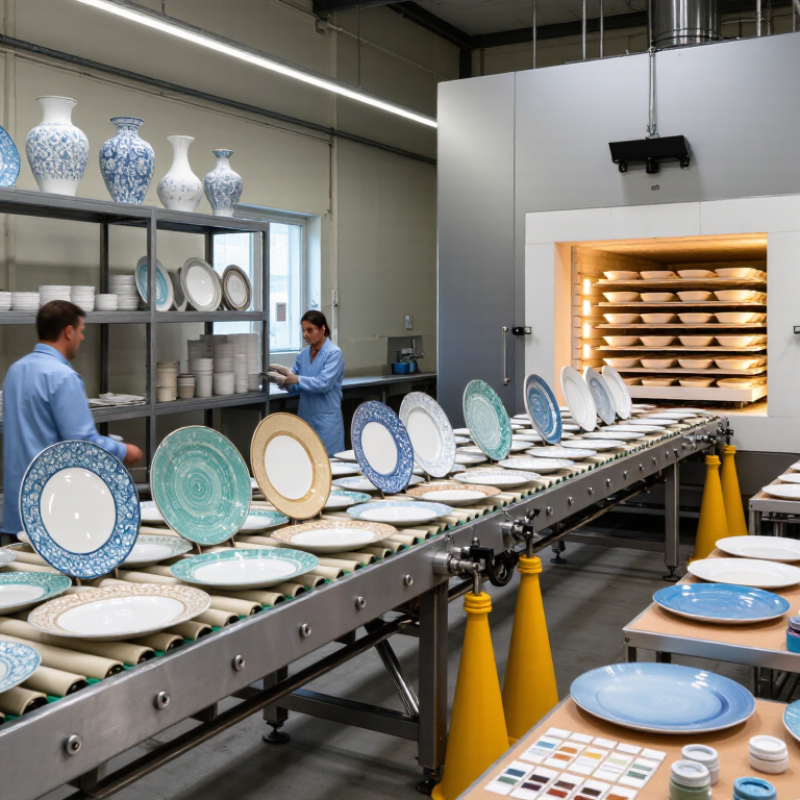
Ceramic decal printing starts with a compatible surface and pigment system. Overglaze decals commonly use ceramic colors held in a printed medium, then applied to a glazed, clean body. Water-slide transfers suit curved cups and plates; screen-printed decals can provide stronger, repeatable coverage on larger runs. The choice matters. Grand View Research estimated the global ceramic tile market at USD 227.7 billion in 2023, reflecting the scale of ceramic production, though that figure does not measure decal printing alone.
Firing needs careful control. After transfer, the paper is soaked, positioned, and smoothed to remove trapped water and air. The piece dries before entering the kiln. Overglaze colors usually mature in a lower-temperature firing than the body beneath them, but the exact curve depends on the color, glaze, and kiln. The European Commission’s Ceramic Manufacturing BREF describes firing temperatures across ceramic products ranging roughly from 800°C to 2,000°C; this broad range is not a decal recipe. Small details matter. A test tile can reveal blurring, pinholes, or weak adhesion before a full batch is fired. Even then, results may vary across kiln shelves. That is an inconvenient, but useful, reminder to record both temperature and hold time.
For decalcomania ceramic printing, the 700–850°C overglaze range is a useful benchmark, not a universal recipe. The European Commission Joint Research Centre’s 2007 Ceramic Manufacturing Industry reference document describes kiln conditions as dependent on product and process. That matters: decal composition, glaze, kiln atmosphere, and ware thickness can shift the result. A glossy cup rim may mature differently from a broad, flat plate. Ask manufacturers for firing curves and test records, not just a peak temperature.
At roughly 700–850°C, the printed layer must fuse without damaging the underlying glaze. Too little heat can leave a rough surface or weak adhesion; excess heat may blur fine lines or alter colors. These outcomes depend on the materials, so a temperature alone cannot guarantee quality. Compare suppliers using sample tiles fired in your own kiln, and record ramp rate, peak hold, cooling time, and color change. Some tests will fail. That is useful evidence, not a reason to hide variation.
Tips: Fire a small batch first. Use a calibrated thermocouple, check the kiln’s hot and cool zones, and inspect edges under angled light. Keep a written firing log; memory is a poor measuring tool.
10 Best Decalcomania Ceramic Printing Manufacturers
How to Evaluate Manufacturers: Color Accuracy, Durability, and Compliance
Choosing a decalcomania ceramic printing manufacturer takes more than comparing sample colors. Ask how the team controls ink, glaze, firing temperature, and kiln placement. These variables can shift a shade from a warm red to a dull brown. Request a color proof fired on the same ceramic body and under conditions close to your production process. Small differences matter. I would not treat one perfect sample as proof of consistent output; ask to review samples from multiple production runs.
Tips: Send a reference color, intended firing range, and finished-use details. Check whether the manufacturer can provide batch records and relevant compliance documents. For food-contact items, confirm the documentation applies to the finished product and its intended use. Ask for records.
Durability checks should reflect real handling, not just a quick rub test. Discuss abrasion, washing, and thermal changes relevant to the product. Look closely at decal edges, fine lines, and areas where colors overlap. Peeling or fading may appear only after repeated use. A manufacturer should explain its test method and share results, while being clear about test limits. Compliance matters too: requirements vary by market and product type, so verify current documentation with qualified reviewers rather than relying on a broad assurance.
A practical evaluation framework for comparing manufacturers. The percentages are suggested assessment weights, not measured ratings of specific companies.
How to use it: Score each manufacturer against the same criteria and evidence. For color accuracy, request approved samples and documented color measurements; for durability, review test results appropriate to the intended use; for compliance, verify applicable standards and traceable documentation. Adjust the weights to match your product and market requirements.
Comparing ten decalcomania ceramic printing manufacturers means looking beyond catalogue images. Check which surfaces they support, such as glazed tiles, curved tableware, or textured pieces. Ask about firing-temperature tolerances, color matching, image registration, and minimum order quantities. These details affect whether a design survives firing with clean edges and consistent color. Small test runs help reveal issues before production.
Market context matters, but it is not a direct measure of decalcomania demand. Grand View Research valued the global ceramic tile market at USD 227.87 billion in 2023 and forecast a 6.5% compound annual growth rate through 2030. That broad figure signals a substantial ceramics sector, not guaranteed orders for any printer. Compare the ten manufacturers using documented sample results, quality-control checks, production lead times, and their ability to repeat a color across batches. Ask for fired samples, not just digital proofs. One weakness in any ranking: published specifications rarely show how a supplier handles a difficult glaze or a rushed reprint. Real production varies. That matters.
Decalcomania ceramic printing can decorate mugs, plates, and small-batch giftware with detailed colors and fine lines. When comparing manufacturers, ask how minimum order quantities change with artwork, color count, and firing setup. A simple one-color design may require fewer setup steps than a multi-color transfer. Lead times also depend on sample approval, kiln schedules, and shipping. Get separate estimates for sampling and production, with dates tied to artwork approval.
Tips: Send a dimensioned drawing and intended-use details with your inquiry. Ask for one fired sample before approving a full run. Check the print under natural light, then inspect edges, color consistency, and placement. Small flaws can be easy to miss on a screen.
For food-contact products, request test reports for the finished ceramic item, not just the undecorated body or print material. Confirm that the tested sample matches the glaze, decal placement, and firing process you plan to order. Ask which conditions the tests cover, such as contact with hot drinks or repeated washing. Requirements vary by destination and use, so verify relevant standards with a qualified testing laboratory. I would not rely on a general “food-safe” claim alone. Keep approved samples and test documents with the purchase record; production changes may affect results.
The process uses ceramic colors held in a printed medium and a clean, glazed ceramic surface. Compatibility matters.
Water-slide transfers can follow curved cups and plates. Screen-printed decals may provide repeatable coverage for larger production runs.
Soak the paper, position the image, then smooth away trapped water and air. Let the piece dry before firing.
About 700–850°C is a useful benchmark, not a universal recipe. Color, glaze, kiln atmosphere, and ware thickness can change the firing needs.
Too little heat may leave rough surfaces or weak adhesion. Excess heat can blur fine lines or change colors. Small details matter.
A test tile can reveal pinholes, blurred edges, or poor adhesion before a full batch is fired. It may still differ across kiln shelves.
Record ramp rate, peak temperature, hold time, and cooling time. Check hot and cool kiln zones with a calibrated thermocouple.
Request fired samples and compare color matching, image registration, supported surfaces, quality checks, and lead times. Digital proofs are not enough. Real production varies.
This guide explains how Decalcomania Ceramic Printing works, from preparing ceramic-compatible materials to applying transfers and completing the firing stages. It outlines common overglaze firing temperatures of approximately 700–850°C, while noting that the right schedule depends on the materials and production requirements. Readers will also find practical criteria for comparing manufacturers, including color accuracy, print durability, production consistency, and relevant compliance documentation.
A side-by-side capability comparison helps buyers assess potential suppliers without focusing on brand names. The guide also covers sourcing considerations such as minimum order quantities, lead times, sample approval, and food-contact testing when products are intended for that use. Together, these topics provide a starting point for selecting a production partner and planning a ceramic printing project with clearer expectations.