Explore high-density, chip-resistant ceramic tableware produced via advanced cold isostatic pressing and automated roller kiln sintering. Designed for global retail brands and hospitality chains.








In the modern international ceramics market, procurement managers and institutional buyers face escalating challenges regarding microstructural integrity, dimensional tolerance, thermal shock performance, and total cost of ownership (TCO). As ceramic tableware and engineered ceramic components move toward higher automation in commercial dishwashing and industrial use, traditional slip casting and plastic jiggering processes frequently fail to deliver uniform density.
This technical sourcing guide evaluates the Top 10 Isostatic Ceramics Suppliers, analyzing how advanced manufacturing paradigms—specifically Cold Isostatic Pressing (CIP) combined with high-temperature roller kiln sintering—redefine quality standards for vitreous china, high-grade stoneware, and technical ceramics.
Isostatic pressing is an advanced ceramic powder compaction process that applies equal pressure from all directions using a flexible elastomeric mold submerged in a liquid or gas pressure medium. When producing flatware (plates, saucers, platters) and high-stress ceramic bodies, this technique overcomes the fundamental physical limitations of mechanical dry pressing and wet slip casting.
By applying fluid pressure uniformly across the mold surface, powder granules achieve optimal particle packing density without shear stress friction. This eliminates localized structural density variations, stopping rim droop and ovalization during high-temperature sintering (1,220°C–1,260°C).
Isostatic pressing utilizes spray-dried ceramic powder with controlled moisture content (usually 1.5%–3.0%), compared to plastic body pugging (18%–22% moisture). This drastically reduces drying shrinkages, shortens production lead times, and conserves thermal energy in industrial kilns.
Commercial foodservice settings suffer high replacement costs due to rim chipping. Isostatic ceramics feature ultra-compacted edge boundaries, boosting edge impact resistance by up to 35% compared to standard jiggered tableware.
| Performance Metric | Cold Isostatic Pressing (CIP) | Automatic Jiggering / Jolleying | Traditional Slip Casting |
|---|---|---|---|
| Green Body Density Uniformity | Extreme (> 99.2% Isotropic) | Moderate (Friction gradients) | Low-Medium (Settling effects) |
| Firing Shrinkage Variance | ± 0.3% | ± 1.2% | ± 2.5% |
| Flexural Strength (MOR) | 120 – 160 MPa | 70 – 95 MPa | 50 – 75 MPa |
| Water Absorption (Vitreous Body) | < 0.2% (Zero Porosity) | < 0.5% | < 1.5% |
| Tooling Setup & Dimensional Stability | Precision CNC Elastomer Molds | Gypsum Plaster Molds (Wears fast) | Plaster / Resin Slurry Molds |
When selecting a tier-1 OEM/ODM partner for large-scale ceramic tableware or technical ceramics, procurement executives must look beyond initial unit pricing. The top suppliers are evaluated based on a comprehensive 5-pillar operational framework:
Leading factories maintain control over raw material refining, ball milling, and spray-drying towers to maintain exact particle size distribution (PSD) and moisture consistency prior to pressing.
Utilization of continuous computer-controlled roller hearth kilns operating with strict temperature zone profiles (±2°C margin) prevents thermal stress and ensures uniform glaze vitrification.
Compliance with ISO 9001 (Quality), ISO 14001 (Environmental), SMETA (Ethical Trade Audits), and AEO (Authorized Economic Operator) status for accelerated international shipping customs.
Rooted in Bangkok and Ratchaburi, Thailand, Crown Ceramics provides global hospitality brands, retail lifestyle groups, and foodservice distributors with end-to-end OEM, ODM, and Private Label solutions. Our production ecosystem blends traditional artisanal craft with automated German and Italian ceramic machinery.
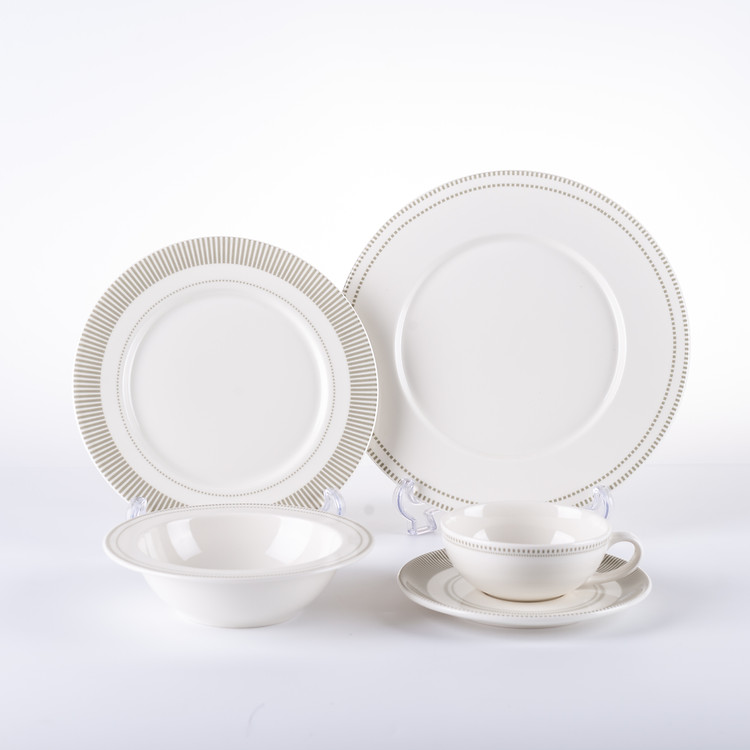

Fired between 1,220°C and 1,260°C. Delivers water absorption < 0.5%. Highly resistant to mechanical impact and edge chipping, making it ideal for intensive HoReCa (Hotel, Restaurant, Catering) environments.
Fired between 1,180°C and 1,230°C with water absorption < 3%. Offers rich tactile depth, ideal for reactive glazes, matte textures, and modern retail lifestyle dinnerware collections.
Warm red clay formulations engineered for oven-to-table bakeware, artisanal serveware, and decorative home items, offering distinct natural aesthetics and thermal retention.
As global buyers refine their procurement operations, several technological and sustainability trends are reshaping the ceramic manufacturing landscape:
Top suppliers are integrating circular manufacturing principles. At Crown Ceramics, unfired green body scrap is 100% reclaimed into slip preparation. Advanced closed-loop water treatment systems filter and reuse process water, minimizing environmental impact while adhering to ISO 14001 standards.
Modern OEM programs no longer rely on weeks of manual plaster carving. Using 3D computer-aided design (CAD) and rapid additive prototyping, master elastomeric molds for isostatic pressing can be validated within 7–14 days, reducing time-to-market by over 50%.
To ensure perfect color consistency across millions of pieces, leading factories utilize robotic spray glazing and precision decalcomania printing. This eliminates drips, pinholes, and uneven glaze thickness, matching tight industrial color tolerances (Delta E < 0.30).
To safeguard global retail and hospitality brands, top-tier ceramic suppliers maintain certified, in-house analytical laboratories. Crown Ceramics conducts rigorous testing on every production batch prior to export container loading:
Extractable Lead (Pb) and Cadmium (Cd) levels are tested continuously, ensuring strict compliance with FDA food contact requirements, California Proposition 65, and European Directive 84/500/EEC.
Bodies and glazes are tested using dilatometers to match thermal expansion coefficients precisely. Samples undergo autoclave crazing resistance tests (10 bar steam pressure) to ensure zero glaze cracking across years of commercial dishwasher thermal shocks.
Pendulum impact testing measures the energy (Joules) required to chip dinnerware edges. Certified pieces withstand upwards of 1,000 continuous commercial dishwasher wash cycles without surface dulling or glaze erosion.

Key insights for B2B buyers, sourcing agents, and product managers evaluating ceramic manufacturing partners.
Partner with South East Asia's premier ceramic manufacturer. Submit your CAD drawings, sample specifications, or target price points to receive a detailed technical evaluation and quotation within 24 hours.
Get a Quote