Fired in automated roller kilns at temperatures up to 1260°C, delivering high thermal shock resistance, zero porosity, and superior glaze mechanical strength.








An in-depth analysis of high-temperature kiln technologies, microstructural vitrification, energy efficiency protocols, and thermal dynamic control systems in modern ceramic manufacturing.
Modern ceramic factories in China utilize continuous roller hearth kilns spanning 100 to 200 meters in length. These automated kilns precise control temperature zones from pre-heating (200°C–800°C) to peak vitrification (1220°C–1260°C) and rapid cooling. The mechanical drive rollers ensure zero vibration, eliminating thermal warpage and guaranteeing dimensional tolerance within ±0.5% across mass production runs.
By modulating air-to-fuel ratios via pulse firing digital burner units, top ceramic manufacturers execute alternating oxidizing and reducing firing cycles. This atmospheric management converts iron oxide ($Fe_2O_3$) to ferrous forms ($FeO$), producing pristine white porcelain body structures with superior mechanical toughness, high modulus of rupture ($>45\text{ MPa}$), and thermal shock failure immunity up to $\Delta T = 160^\circ\text{C}$.
Leading Chinese industrial kiln suppliers have integrated waste heat recovery heat exchangers directly into the flue gas exhaust systems. Recovered energy is recycled to pre-heat combustion air up to 350°C and supply hot air to spray drying towers. This architecture reduces natural gas consumption by up to 28% per metric ton of fired ceramic, drastically lowering the product's carbon footprint.
Sourcing teams must select the appropriate kiln infrastructure based on product geometry, batch size, and thermal vitrification requirements.
| Kiln System Type | Peak Temperature Range | Atmosphere Precision | Thermal Uniformity | Ideal Application Scope | Energy Efficiency |
|---|---|---|---|---|---|
| Automated Roller Hearth Kiln | 1180°C – 1280°C | High (Oxidizing/Reducing) | ± 2°C cross-section | Flatware, Vitrified Dinnerware, Coupe Plates | Optimal (Continuous Heat Recov) |
| Shuttle Kiln (Batch Type) | 1200°C – 1350°C | Ultra-High (Individual burner control) | ± 3°C batch-wide | Custom Sculptural Ware, Terracotta, Mugs | Moderate (Intermittent cycle) |
| Tunnel Kiln (Continuous) | 1250°C – 1320°C | Medium to High | ± 5°C cross-section | Mass Production Hotel Porcelain & Sanitaryware | High (Constant thermal loading) |
| Electric Micro-Kiln | 1000°C – 1200°C | Pure Oxidizing | ± 1°C electronic control | On-Glaze Decal Firing, Precious Metal Trim | High (Clean Electric Energy) |
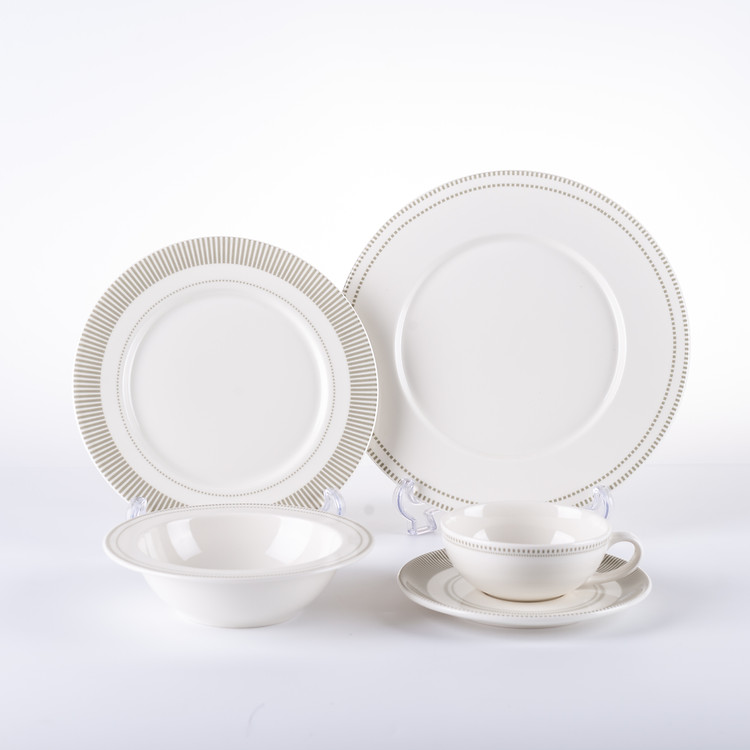
As a premier ceramic manufacturing enterprise operating across dual production hubs spanning over 150,000 square meters, we combine advanced European machinery with rigorous raw material refining. Our facility utilizes high-pressure Isostatic Forming presses and fully automated spray glazing lines to achieve flawless structural density.
Every raw clay slurry batch undergoes particle size distribution analysis ($D_{50}$ controlled between 2.5 to 3.8 microns) and magnetic iron separation to ensure structural purity before entering the firing phase. This commitment guarantees that every piece delivered meets global hotelware and commercial retail specs.
Protecting your global reputation with comprehensive chemical, physical, and thermal validation testing on every mass production lot.
To strictly comply with FDA 21 CFR 175.300, California Proposition 65, and European Commission Directive 84/500/EEC, our lab conducts 24-hour acetic acid leaching tests. Using atomic absorption spectroscopy, lead ($Pb$) and cadmium ($Cd$) migration limits are verified below $0.05\text{ mg/L}$ and $0.01\text{ mg/L}$ respectively.
Crazing occurs when glaze and ceramic body thermal expansion coefficients mismatch. Our optical dilatometer measures coefficient of thermal expansion ($\text{CTE}$) from 20°C to 600°C, maintaining a precise tension fit ($\Delta \alpha = 0.2-0.4 \times 10^{-6}/\text{K}$) between glaze and body to guarantee lifetime crazing resistance under heavy dishwasher cycles.
 ISO 9001 Quality
 ISO 14001 Eco
 SMETA Audited
 AEO Customs
.jpg) Food Safe Certified
Food Safe Certified
Key technological shifts reshaping global B2B procurement calendars, material formulations, and supplier evaluation benchmarks over the next five years.
With global net-zero targets taking effect, Chinese suppliers are transitioning high-temperature kilns toward green electric heating and hydrogen-blend natural gas burners. Importers will increasingly demand carbon intensity audit reports ($kg\text{ CO}_2/kg\text{ ceramic}$) to clear carbon border adjustment tariffs (CBAM) entering the EU and North American markets.
By incorporating synthetic alumina ($\alpha\text{-Al}_2\text{O}_3$) and magnesium silicate flux agents into kaolin formulations, manufacturers can reduce wall thickness by 15% to 20% while increasing mechanical impact resistance by 30%. This innovation cuts container freight costs and handling weight for hospitality chains.
Industrial 4.0 integrated ceramic factories utilize Digital Twin simulation models inside the roller kiln zones. Real-time infrared sensors feed structural expansion data to AI controllers, adjusting local gas burner intensity on-the-fly to achieve zero warpage across complex asymmetric geometries.
Detailed technical answers addressing ceramic body composition, kiln firing physics, OEM lead times, and customs documentation.
Vitreous China is formulated with higher concentrations of kaolin feldspar fluxes and fired at 1240°C–1260°C until the body completely vitrifies, resulting in a water absorption rate under 0.5%. Stoneware is fired between 1180°C–1230°C with water absorption up to 3%. Vitreous china offers superior edge-chip resistance and mechanical strength, making it ideal for high-impact commercial foodservice, whereas stoneware provides organic tactile glazes suitable for retail lifestyle brands.
For custom OEM stoneware and terracotta collections, minimum order quantities typically start at 2,000 pieces per shape and decoration. For high-fire vitreous china requiring specialized steel dies and mold setups, standard production runs start at 3,000 pieces. Repeat buyer programs and mixed-container shipments (combining plates, bowls, and mugs) can be optimized to balance inventory turns with ocean freight container filling efficiency.
Once CAD drawings or reference physical samples are approved, preliminary 3D-printed resin models or hand-thrown plaster models are produced within 7 to 10 working days. Master mold creation, initial slip casting, glaze color matching, and laboratory pre-production sampling require an additional 21 days. Full-scale continuous roller kiln production and container loading generally require 45 to 60 days following pre-production sample sign-off.
Deformation during the vitrification phase (1200°C+) is prevented through precise alumina oxide setter setters (saggars), controlled roller pitch spacing, and uniform heating profile across the top and bottom burner zones. By maintaining a maximum cross-sectional temperature variance of less than ±2°C, the liquid phase silica stays uniformly distributed without sagging or oval distortion.
Every shipment is accompanied by a comprehensive Quality Control Certificate of Analysis (COA), heavy metal leach test reports (FDA / EU compliant), Commercial Invoice, Packing List, Bill of Lading, and Country of Origin Certificate. Our export department holds Authorized Economic Operator (AEO) status, expediting customs clearance and security verification through major global ports.
